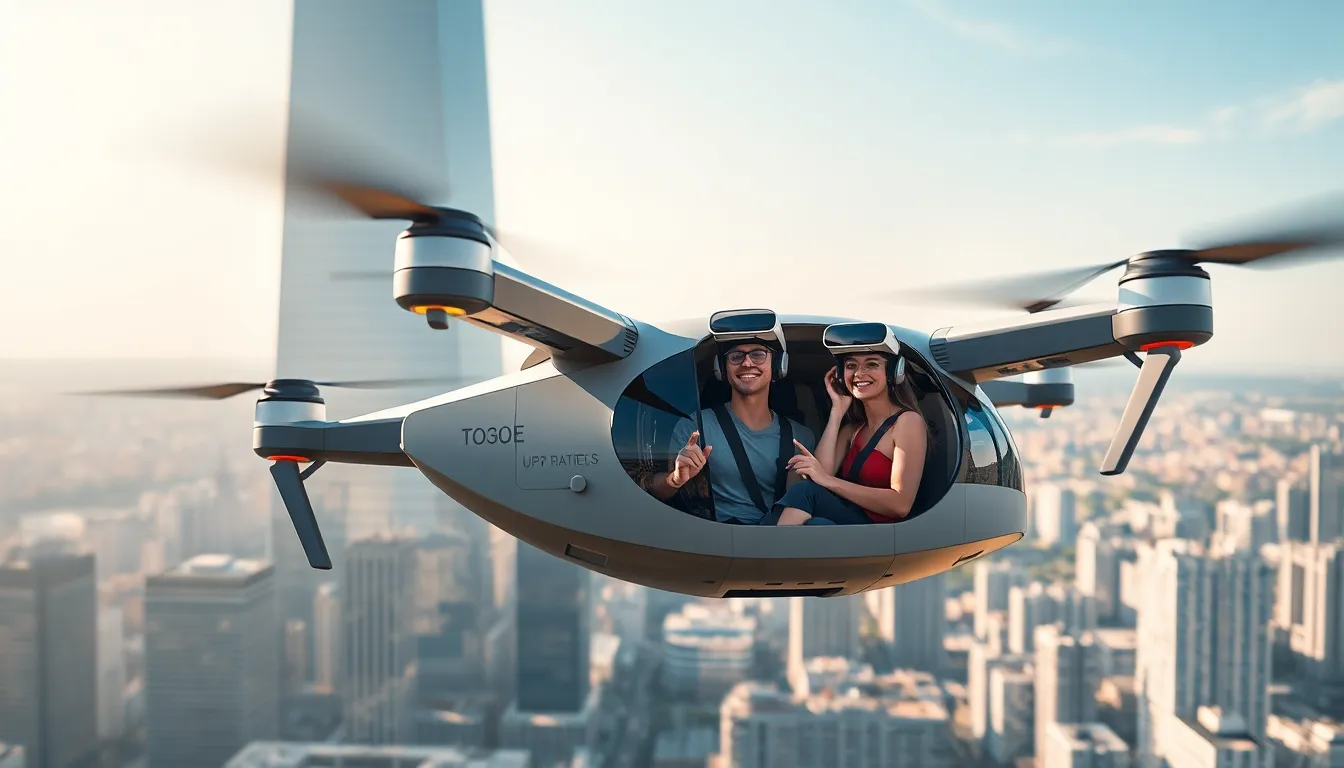
Imagine zipping through the sky like a superhero, dodging traffic jams and leaving the daily grind far below. Drones that carry people are no longer just a figment of sci-fi movies; they’re on the verge of transforming urban transportation. These flying machines promise to whisk passengers from point A to point B faster than you can say “Are we there yet?”
Overview of Drones That Carry People
Passenger-carrying drones are a rapidly evolving segment of the aviation industry. Currently, several prototypes and models are under development to address urban transport needs. Companies such as Volocopter, EHang, and Joby Aviation lead the charge in creating innovative aerial vehicles designed for passengers.
These drones typically operate as electric vertical takeoff and landing (eVTOL) aircraft. Many designs feature multiple rotors for stability and redundancy. Some models aim to accommodate two to four passengers, optimizing for short-distance urban travel.
In many urban settings, these aerial vehicles potentially reduce travel times significantly. For instance, a trip that takes 60 minutes by car could take only 15 minutes by drone, transforming the commuting experience. Regulatory bodies, including the Federal Aviation Administration (FAA), are actively involved in shaping rules around drone operations, ensuring safety as a priority.
Safety features are a fundamental aspect of drone design. Collision avoidance systems, backup power supplies, and redundant control systems enhance flight safety. Pilots often control these vehicles remotely while systems designed for automation respond to real-time data inputs.
Investments in this technology continue to grow, with billions allocated to research and development. The global aerial mobility market is expected to reach $1.5 trillion by 2040. This surge reflects strong interest from both consumers and investors in urban aerial mobility solutions.
As technology matures, public acceptance of passenger drones is likely to increase. Enhanced infrastructure, including designated landing zones and charging stations, will support this new mode of transport. The future holds promise for these innovative vehicles to seamlessly integrate into the urban landscape, offering efficient and dynamic travel options.
Types of Passenger Drones
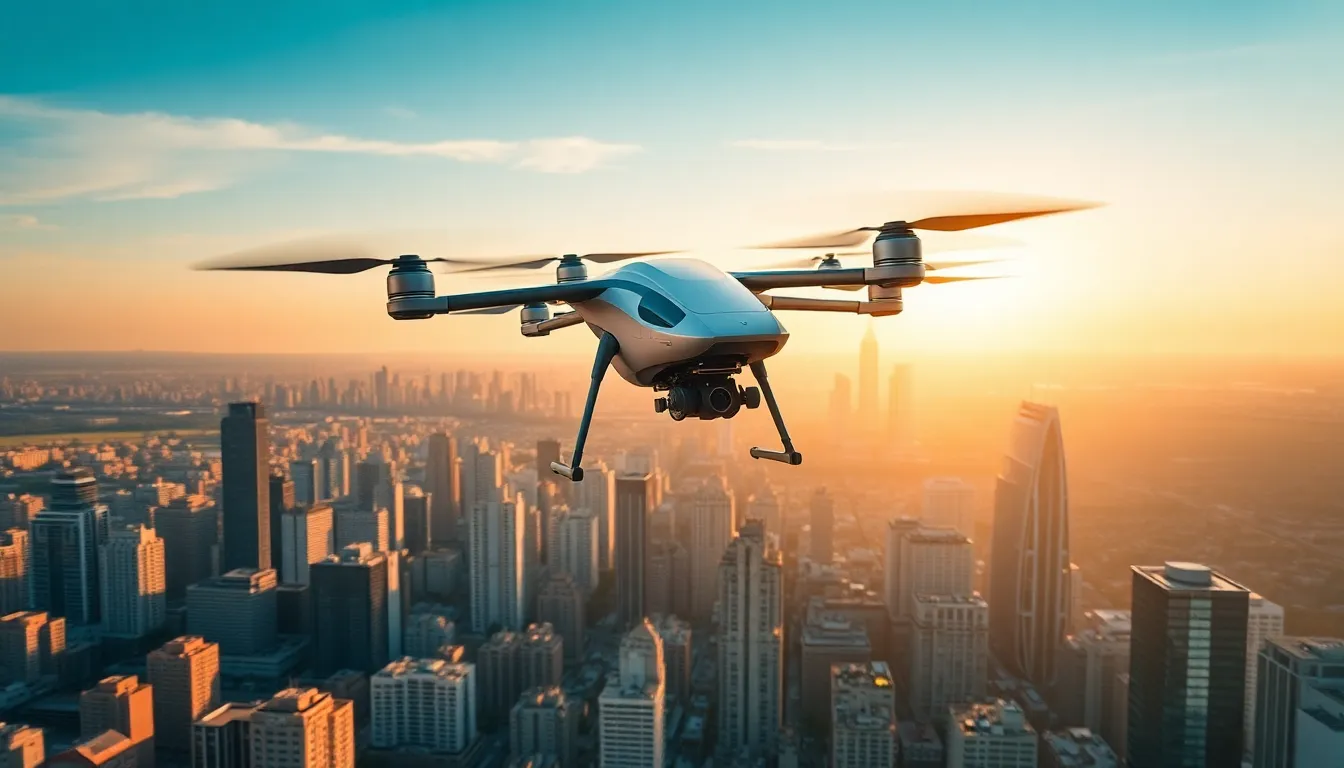
Passenger drones come in various designs, primarily categorized as multi-rotor and fixed-wing drones. Each type serves different needs in urban air mobility solutions.
Multi-Rotor Drones
Multi-rotor drones feature several rotors, typically ranging from four to eight. These drones excel in vertical takeoff and landing, making them ideal for urban environments. They accommodate two to four passengers and offer enhanced maneuverability. Companies like Volocopter focus on this design, ensuring stability and safety with redundancy in rotor systems. Battery technology advancements enhance their range, allowing journeys of up to 30 miles in urban settings. The simplicity of operation promotes quick deployments in busy areas, creating significant advantages in alleviating traffic congestion.
Fixed-Wing Drones
Fixed-wing drones operate differently than multi-rotor models, relying on wings for lift. These drones generally require longer runways for takeoff and landing. They offer superior speed and range, often exceeding 60 miles per hour and capable of traveling distances over 100 miles. Joby Aviation is one such company developing this technology for urban transport. Fixed-wing passenger drones tend to be more efficient for longer trips, appealing to commuters who live in suburban or semi-rural areas. The design’s aerodynamic efficiency contributes to lower energy consumption, making them environmentally friendly options.
Key Features of Drones That Carry People
Passenger drones come equipped with several key features that enhance their functionality for urban travel.
Flight Range and Speed
Flight range varies significantly based on the drone’s design and technology. Multi-rotor drones typically reach a distance of up to 30 miles, ideal for short urban commutes. Fixed-wing drones, on the other hand, can travel over 100 miles while maintaining speeds exceeding 60 miles per hour. For instance, Joby Aviation’s models target efficiency for longer suburban commutes. These speed capabilities drastically reduce travel times, turning a 60-minute car ride into a 15-minute aerial journey. Battery advancements and lightweight materials contribute to the improved performance of passenger-carrying drones.
Safety Mechanisms
Safety mechanisms are paramount in the design of passenger drones. Collision avoidance systems play a critical role in preventing accidents during flight. Many drones utilize multiple sensors to detect and navigate around obstacles. Backup power systems ensure that drones can land safely in case of power failure. Remote piloting features add an additional layer of security, allowing operators to manage flights as needed. Regulatory oversight from entities like the Federal Aviation Administration enhances the safety protocols in development. As technology evolves, these robust safety features build confidence in passenger-carrying drones, contributing to their market growth.
The Current State of the Industry
Passenger-carrying drones are rapidly advancing, with significant impact anticipated in urban transportation.
Leading Manufacturers
Companies like Volocopter, EHang, and Joby Aviation dominate the passenger drone landscape. Each focuses on the design of electric vertical takeoff and landing aircraft that cater to urban commuting. Volocopter’s multi-rotor drones excel in maneuverability; they accommodate two to four passengers, making them suitable for short trips. EHang emphasizes automation and safety, aiming for an effortless user experience. Joby Aviation, with its fixed-wing design, offers longer ranges and higher speeds, appealing to suburban commuters. All these manufacturers contribute to a varied market, showcasing unique approaches to addressing urban transportation challenges.
Regulatory Challenges
Regulating passenger drones poses complexities for authorities. The Federal Aviation Administration (FAA) actively develops rules that ensure safety and operational feasibility. Challenges include establishing air traffic management systems capable of integrating drones alongside traditional aircraft. Approval processes for new aircraft design and operation frequently delay market entry. Public safety remains a priority, prompting rigorous testing and certification requirements. Stakeholders must also address concerns related to noise pollution and community acceptance. This evolving regulatory landscape will shape the future of passenger drone integration into urban environments.
Future of Drones That Carry People
Passenger-carrying drones represent a significant evolution in urban transportation. Innovations continue to reshape this industry, paving the way for an exciting future.
Technological Advancements
Battery technology advances significantly extend journey ranges. Enhanced collision avoidance systems improve safety and operational reliability. Companies focus on integrating artificial intelligence for real-time navigation, making autonomous flights more feasible. Improvements in lightweight materials contribute to overall efficiency, allowing for better performance. The ability to incorporate advanced sensors ensures more accurate flight data. Innovations in communication technology enhance remote piloting options, expanding operational capabilities.
Market Potential
The global aerial mobility market is projected to reach $1.5 trillion by 2040. Significant investments drive research and development, expanding opportunities for passenger drones. Emerging urban air mobility services promise to address traffic congestion effectively. Suburban and semi-rural areas stand to benefit from reliable commuting options. Growing interest from investors and tech companies fuels market growth. Public acceptance is anticipated to increase as these drones prove their reliability and safety.
Passenger-carrying drones represent a transformative leap in urban transportation. As technology advances and regulatory frameworks adapt, these innovative vehicles are set to reshape how people navigate cities. With the potential to drastically cut travel times and reduce congestion, the appeal of flying over traffic is undeniable.
The ongoing developments in safety features and efficiency continue to build confidence among potential users. As public acceptance increases and infrastructure evolves, passenger drones could soon become a common sight in urban skies. The future of commuting looks not only faster but also more sustainable.